Hope for Farmers and Our Food in 2026!
posted on
January 1, 2026
2025 was a challenging year for most farmers in America. Input prices continued to rise, while commodity prices at which farmers sell their goods remain unchanged in our area and in many parts of the U.S. This, coupled with challenging weather patterns that have reduced yields, has caused many farmers to suffer.
According to the 2025 Agricultural Lender Survey, a survey sent to banks that lend to farmers nationwide, 93% of all banks expect farmer debt to increase over the next year. The National Corn Growers Association expects corn, our country's most prized crop, to net farmers a profit of -$0.85/bushel (Or an average loss of $150/acre). That’s correct: with current input costs subtracted from the price of the grain, most farmers will incur a loss on their corn crops.
Well, that’s just one crop, right?
Wrong - Most farmers growing crops to sell at the commodity market will see very little or no margin of profit for their work this year. Next year doesn’t look much better either.
So how did we get here?

Farming in history has always had good times and bad times. We hear in the Bible of the 7 years of bounty and 7 years of famine; the great potato famine of 1845; and, most recently, for the American farmer, the Dust Bowl. Most of these were caused by weather-related or natural factors; however, this time, it is a much deeper problem.
Input costs for corn (on average in the U.S.) have reached $897 per acre. This includes Chemicals, Fertilizer, Seed, Land Rent, Wages, and Equipment Costs. We observed a substantial increase in all of these costs first in 2020 during the COVID-19 pandemic. Restrictions on trade and future uncertainty led chemical and fertilizer manufacturers to raise prices, as most of the components of these products are imported.
The price of land and, subsequently, land rent have been on a constant rise forever. It has recently become a huge problem because the price has reached the point where farmers can no longer afford to purchase their own land. Their income from selling the crops and livestock they raise is insufficient to buy the land required to continue operations.
Who’s going to purchase farm land?
Enter the billionaires who now view farmland as a lucrative investment and are willing to pay substantial sums for it, thereby further inflating prices. As the price of farmland rises, land rent must also increase to cover the cost of the land. Increasing the farmers' cost per acre.
Farmers are earning less than ever, and they are receiving little cash for their crops. Here’s a chart of corn prices since 2000. As you can see, the price has experienced significant fluctuations but, overall, has increased little relative to the cost of growing corn.

Great, farmers are making less money than ever, but when I go to the grocery store, the cost of everything just keeps going up! What's the deal with that?
Let us keep looking at it from the farmer's perspective to see what is happening. We’ll keep rolling with corn since that’s where we started, but the general idea can be put to any crop grown on a commodity scale. According to the USDA, here is how the corn grown in America is distributed.
Use | Percentage of Total Corn Production |
Livestock feed | ~37–40% |
Ethanol & byproducts | ~30–35% |
Exports | ~10–15% |
Food products | ~10% |
Seed & industrial | ~3–5% |
This chart shows that pigs, chickens, and cattle consume the largest quantities of corn grown in the United States. A few major integrated buyers control more than 30% of all of the corn purchased for animal feed. These are companies like Perdue, Tyson, Cargill, Smithfield, and JBS.
You’ve probably heard those names or eaten products from these companies a time or two. These integrators account for over 60% of all proteins consumed in the United States. This gives them control over not only the costs of products on supermarket shelves. They can always find ways to manufacture their product more cheaply, which entices consumers (not necessarily you, because you care about where your food comes from) to purchase it.
They know that a major input in the production of their product is corn, that it’s being overproduced, and that if they purchase enough of it, they can control the price they pay to farmers.
Every year, these integrators gain market share and strive to own more of the process, so ultimately they can have greater control over where the money goes. Let’s take a quick birds-eye view of how these vertical integrators got their start.
Around 1940, one of the first instances of integration occurred in poultry production when Arthur Perdue and his son, Frank, founded Perdue Farms. They saw a problem: chickens grew too slowly, didn’t taste good, and they were too expensive. He established his own breeding operation and persuaded farmers to raise his birds by contracting to purchase them back once they were full-grown.
This business model allowed farmers to assume much less risk in adopting new chicken breeds while allowing the Perdue family to capitalize on their hard work.
Their business gradually evolved into supplying farmers with everything they needed to raise birds. This was a significant relief for farmers, who could not manage the large market swings and rising input costs in the 70’s and 80’s.
From there, the business expanded into the processing and marketing of poultry to supermarkets and restaurants. From the farmers' perspective, it was a no-brainer to join. What had been a long, risky business of raising a bird and marketing it himself, hoping someone would buy it once fully grown, became a quick and easy way to generate cash flow and keep the family farm afloat.
The Cargills and what is now known as Smithfield, alongside a few others, quickly adopted the Perdue family business model, integrating the beef and pork industries into what we know today. Fortunately, beef is somewhat more challenging to integrate because of the long time required to raise a calf to slaughter. That does seem to be changing now as time goes on, but that’s a story for a different day.
Back to the story at hand -
Since these integrators control the majority of the feed and, in turn, the majority of the market on which a corn farmer can sell their crops, they can control the price at which they choose to pay for it. Because there is excess corn production, they can be very stingy in setting their prices to ensure profitability.
So why don’t farmers just grow less corn?
Well, it’s not that simple. In the eyes of the farmer, if the dollars per acre are getting smaller, the most obvious solution to keep the family business afloat is to plant more acres. If you generate a profit of $10 per acre on all of your farm land, but only have 100 acres, that’s only $1,000 that you would have to reinvest back into your business; however, if you farm 10,000 acres, that yields $100,000 to reinvest in your business.
There is a real advantage in the commodity farming world to having more acres. You have more scale, which generally means your cost per acre decreases. This problem has been responsible for the dissolution of more than 140,000 farms during 2017-2022. That is a 7% drop, according to Northern Ag Network. As we’ve seen throughout history, the fewer hands that control, the more controlling those hands can be.
How do we fix it?
It is not a simple solution. If you wanted to start a farm, it would be nearly impossible without an enormous amount of cash on hand. There's a saying in the farming community that the best way to make a million dollars farming is to start with two million. Which, if you're growing commodity crops, is probably true.
We were stuck on the commodity merry-go-round for years, but we have finally gotten off of it.
Here's how we did it.
To get a good picture of the history of our farm, we must go back about 150 years, when my great-great-grandfather began selling produce from his farm into the neighboring coal towns. He would load his wagon, which eventually became a truck, and go door to door, selling the crops he grew. The wives of the miners could not grow the food needed to keep their growing families' bellies full, so they relied on the farmer to keep the pantry full.
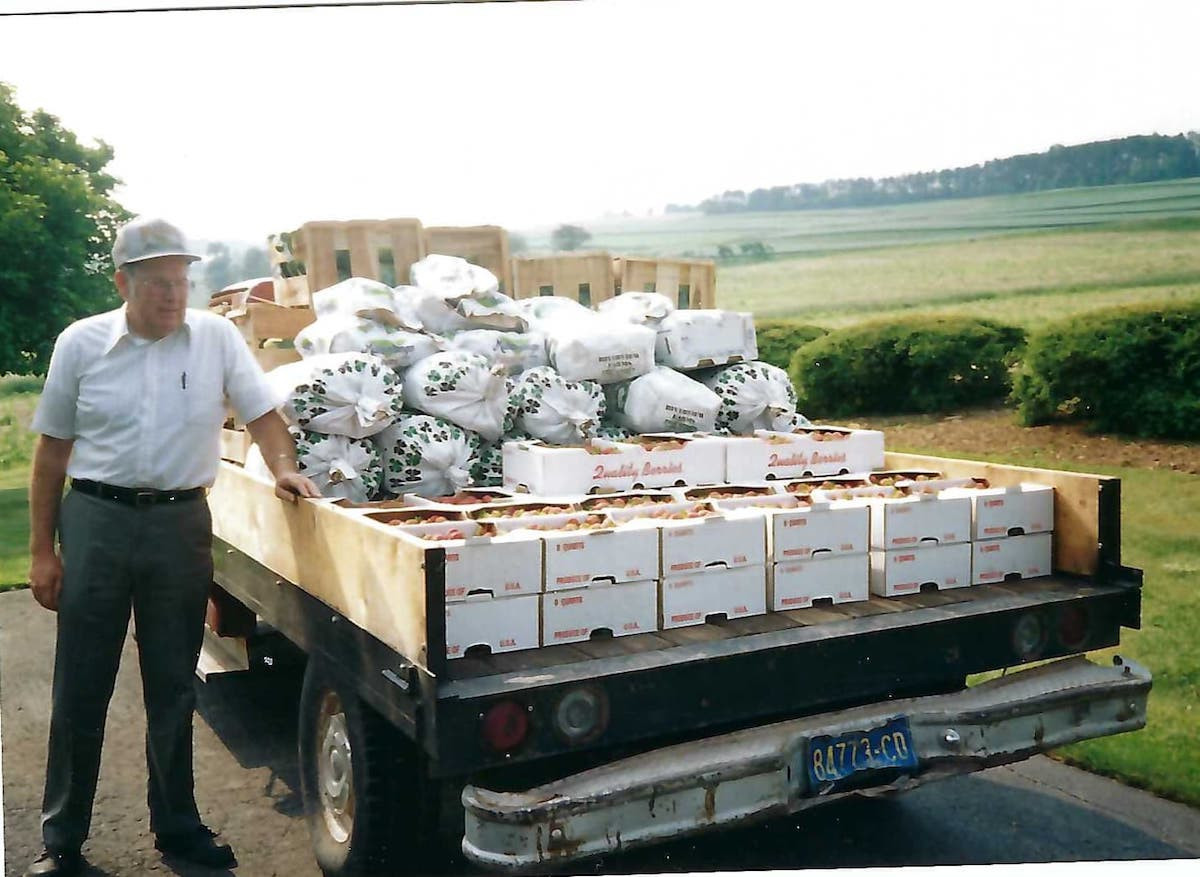
This was a sound and substantial business model for over 80 years, continuing until my grandfather’s time on the farm. During my grandfather’s tenure on the farm, he observed a shift toward people choosing to go to the grocery store rather than wait for the farmer to deliver. Culture was shifting.
Coal was running out in these towns, and new mining practices meant that the next generation had to leave to find jobs. Many women worked in factories during World War II, and some of them stayed to help provide for their families. The grocery store offered something they couldn’t get from personal door delivery from farmers. You could get all of your goods at one spot, rather than waiting all day at home, hoping not to miss your butcher, milk man, or farmer.
My grandpa saw this cultural shift and knew he needed to shift too to keep the farm afloat. We began growing produce and selling it directly to the grocery stores.
This was a great business at first. Slow and expensive transportation meant it was best for grocers to purchase food locally. They supported their farmers in ways that now seem crazy. Grandpa describes the times when potatoes were plentiful, when produce managers would run sales and work with the farmers to move their product.
Like all good things, this came to an end. Advancements in transportation and economies of scale took over. Farmers in areas with better, more controlled climates and fertile soils could produce crops more efficiently and at a lower cost than we can. The biggest change came when the federal water projects built the infrastructure needed to irrigate the previously desert-like climate. Farmers could now perfectly time when the crops get water, giving the best environment to grow a higher-yielding crop. Pair that with the advancements in the transportation industry that made it relatively cheap, it is a no-brainer for the grocery store to buy its produce from farther away at a lower price.
We played the commodity game for 50 years. By then, we were tired of it. There will always be a farm bigger than yours that can do things more economically. Let's face it, most businessmen in corporate America care about one thing: cost. So they will always ride the cheap hand.
Competing on price left our farm depleted. Economically, emotionally, and environmentally. We knew we needed to change, we just weren't sure how. Looking backwards, we admired our forefathers' ability to connect with the people who actually ate their food.
We decided to throw our hands up, waive the white flag on the commodity game, and get closer to our customers. Although very scary and uncertain at the time, it was one of the best decisions we ever made on our farm.
We began by growing specialty potatoes, allowing us to sell them at a higher price. It was challenging to find customers and manage the systems required to produce and distribute this special potato, but ultimately it yielded higher margins and profit per acre.
This margin gave us flexibility to try new approaches. We began covercropping and no-tilling in between potato crops. All things that improved our land. Although we still were not selling our crops directly to the end consumer, we were much closer to them.
We still wanted to make our land and business better, so we really jumped off the deep end and added livestock back to the mix. For the first time in over 50 years, we had cattle on our farm. Like most things, the first year was an abject disaster. With persistence and patience, we finally got the hang of it.

In 2020, we started the journey of something we’ve been dreaming of for years. Selling the food we grow, directly off the farm and into the hands of the families who will be eating it. It has meant so much more to our farm than we ever could have imagined.
It has given us freedom from the constraints of the commodity market. It has also allowed us to become better farmers. We get to talk directly with you, and learn what you are concerned about and ultimately, what we can do to help alleviate those concerns, whether it is what we feed our animals, put in our soils, or simply how we farm. This connection has given us the perspective of someone looking from the outside in, something that was very hard to come by when selling to a few big customers.
Why aren’t more farms doing what we did and leaving the commodity world?
There are lots of factors that go into it. First, it requires a desire for change. It can be terrifying deciding to turn away from something you’ve known and done for years. The average age of farmers in the U.S. is 58 years old, according to the 2022 census. How much changing do you really want to do when you're 7 years away from retirement? It’s the next generation taking over these farms that will need to change to keep the business going.
Some farms have already begun implementing the change. It is interesting, at least in our area, that more farmers are starting to adopt the idea of getting closer to their customers. I look forward to seeing what farms look like in 10-15 years.
The government, although it is trying to help farmers in a time of need, has not been doing farmers any favors. Most government subsidies and aid for farmers have been propping up a broken system. It would be desirable if farmers could afford to be in business and would not have to rely on external funds just to keep feeding our country.
So what can you do to help?
Well, you’ve already started the first step! Educate yourself on where your food comes from. To truly make a difference, get closer to your farmer and the land where your food comes from.
I talk with many people, farmers and non-farmers alike, and some think that if we could just get the right individual in a political office, our farms and food would be much better off. While this is true to an extent, there is only so much one person can do.
You, alongside millions of other families concerned about the safety and stability of our food, have the opportunity to make a difference every time you choose your meal. By purchasing food that is closer to the farm, more of it will go to the farmer and be reinvested in our land and local community.
At first glance, it may be more expensive and time-consuming to shop from farms rather than the supermarket, but it will be well worth your while in the difference it will make in your health, your community, and the next generation.
I would like to conclude with this thought. Cambridge University recently surveyed families who purchase food from farmers to identify the most significant barriers to sourcing food right off the farm. The responses were as I would have imagined, with cost and availability being at the top of the list. To me, this is a relative problem.
Looking back to the founding of the United States, consider how much of our resources (time and money) were spent on obtaining food. Pretty much, I’d think. I’d venture to say easily over 50% but probably closer to 60% or 70%.
Today, the median household income for a family is right around $130,000. If they take home $100,000/year (after taxes) and spend 25% of that on food, you’d have around $70/day to spend on food for your family. From our farm, to get a good crockpot dinner shipped to you, you’d pay approximately $41.50. $36.00 for the Chuck Roast, $3.00 for the spuds, $1.50 for carrots (supplied from another local farm), and $1.00 for spices. For a family of 4, this would be plenty to fill everyone’s plate for one night and even give leftovers for the next day!
I don’t mean to be naive in saying this, because I do understand things are a lot different in today’s world. The settlers didn’t have to pay a mortgage, enroll the children in a good daycare, or have a car payment. But think of all of the good food and local businesses we could support if we would just put a few more resources into where our food comes from.
We believe that food is an investment not only in your health but also in your community. The choices you make in where you source your food have some of the most significant effects on the environment, economy, and the lives of farmers who hope to continue their legacy.
All farmers deep down have a desire to feed people. It’s you, the customer, who can choose to support farms that want to support you. In doing so, you can give more farmers hope, trust, and encouragement to continue, and help them adjust their farms to improve. Better for them, better for you, and better for the world.
Get out and find a farmer to support today. We’d love it if you’d join us, but there are also lots of other great farmers who would love to help you put good food that you can be proud of on your table.
Encourage your friends and family to do the same, and as a community, we can set the next generation up with a better environment, a connection to their food, and a better life for both farmers and food eaters!